Beyond the Traditional Path: Expanding Career Possibilities in Architecture

Only 1 in 4 architects plan to stay in traditional practice. In a June 2026 ACSA webinar, Erin Pellegrino and Jake Rudin mapped the full landscape of where an architecture education can take you — and how to make the transition responsibly.
Quick Answer
Only 1 in 4 architects plan to stay in traditional practice. An architecture degree can lead to UX and product design, real estate development, construction technology, design strategy, sustainability consulting, public interest work, research, entrepreneurship, and organizational leadership. The key is learning how to translate architectural experience into language other industries understand.
Authors: Erin Pellegrino & Jake Rudin
Event: ACSA webinar, moderated by Jori Erdman (James Madison University)
Why This Conversation Matters Now
In June 2026, Out of Architecture co-founders Erin Pellegrino and Jake Rudin joined the Association of Collegiate Schools of Architecture (ACSA) for a webinar titled Beyond the Traditional Path: Expanding Career Possibilities in Architecture, moderated by Jori Erdman, Professor and Program Coordinator of Architectural Design at James Madison University.
The session asked a question students, faculty, and firm leaders need to hear earlier than they usually do:
What does an architectural education prepare you to do beyond conventional practice?
Our answer, based on nearly a decade of coaching more than 10,000 design professionals and helping 300+ employers hire design-trained talent, is simple: architectural training is one of the most transferable professional educations available, but most people are taught to describe it too narrowly.
This article captures the core ideas from that session for students, recent graduates, career changers, and educators planning for Fall 2026 and beyond.
What “Beyond Traditional Practice” Means
“Beyond traditional practice” does not always mean leaving architecture forever. For some people, it means moving out of architecture into another industry. For others, it means moving adjacent to practice: owner-side roles, real estate, construction technology, workplace strategy, sustainability, public agencies, or design operations.
A better career question is not “Should I stay or go?” It is:
Which parts of architecture do I want to keep using, and which parts am I ready to stop organizing my life around?
That framing gives students and professionals more room to make honest decisions. Someone might love spatial problem-solving but not want the traditional licensure path. Someone else might love working with clients but not want consultant coordination forever. Both are valid outcomes of an architectural education.
The Statistic That Reframes the Profession
We opened the ACSA webinar with a data point that changed the tone of the room:
| Finding | Implication |
|---|---|
| 1 in 4 architects plan to stay in traditional practice | 3 in 4 are exploring in, out, or adjacent paths |
| Most architecture students still value their education despite studio intensity | The problem is rarely the training; it is often the narrow job funnel |
If three quarters of trained architects are looking beyond conventional roles, the profession needs a wider default conversation. Not a panic conversation. Not a “what went wrong?” conversation. A practical one: here is what this education prepares you to do, here are the roles that use those skills, and here is how to make the move responsibly.
We Believe in the Value of Architectural Education
Before listing alternate careers, we state this clearly: we believe in the value of architectural education.
Ask most architecture students or graduates whether they appreciate their training, and the answer is usually yes. The design studio—despite long hours and high stakes—builds something rare: people who can think in systems, communicate visually, coordinate complexity, and hold competing constraints in balance.
The gap is not that schools fail to teach valuable skills. The gap is that education and practice are often misaligned, and students are rarely shown the full map of where those skills can go.
As Jake Rudin noted in the webinar, the list of possible career paths should be shared with incoming architecture students — not as a threat, but as a map. That is a sharp contrast to the discouraging message many students still hear early in school.
What Architectural Training Actually Builds
The ACSA session description named five skill clusters that translate across industries. In our coaching work, we see these show up again and again in successful career transitions:
- 1
Design thinking
Framing ill-defined problems and generating structured options
- 2
Critical thinking
Evaluating trade-offs under constraint
- 3
Storytelling
Communicating ideas through narrative, visuals, and presentation
- 4
Systems analysis
Understanding how parts relate to wholes across teams, codes, budgets, and timelines
- 5
Creative problem-solving
Producing elegant solutions when requirements conflict
Key Insight
Architecture is very good at making makers. We were molded into designers and thinkers who could synthesize a variety of skills and emerge with something elegant—in every sense of the term. Architecture trains people to make sense of messy inputs: client needs, site constraints, budgets, codes, climate goals, team dynamics, and incomplete information. Many industries need exactly that kind of person.
Business Success Skills vs. Architecture-Trained Skills
One of the most practical segments of the ACSA webinar mapped Harvard Business School's Essential for Success against skills honed through architecture study and practice — the two frameworks run almost parallel.
Employers outside traditional AEC firms rarely ask for a portfolio of built work first. They ask whether you can lead ambiguity, communicate clearly, manage stakeholders, and deliver under pressure. Architects already do this — but they often describe it in architecture language when the hiring manager is listening for business language.
| Professional success competency | How architecture training develops it |
|---|---|
| Strategic thinking | Programming, master planning, and design concepts that balance user needs, context, budget, and regulation |
| Data-informed decision-making | Performance modeling, area takeoffs, cost estimating, and iterative design testing |
| Financial literacy | Fee structures, project budgets, value engineering, and client ROI conversations |
| Project management | Multi-phase delivery, consultant coordination, milestone tracking, and deadline management |
| Leadership & collaboration | Studio critiques, interdisciplinary teams, client presentations, and site leadership |
| Communication & negotiation | Pin-ups, client meetings, contractor coordination, and stakeholder alignment |
| Emotional intelligence | Navigating critique, team dynamics, client expectations, and high-stress delivery |
| Networking & relationship-building | Juries, professional associations, competitions, and repeat client work |
If you are transitioning out of traditional practice, your task is not to become someone new. It is to translate what you already do into language hiring managers in other industries recognize.
Architecture Degree Jobs Outside Traditional Practice
The webinar highlighted graphics showing the breadth of roles our clients and community members have pursued. Below is a practical map organized by the kind of work you may want to keep doing.
If you want to keep designing experiences
- UX / UI designer
- Product designer
- Brand and experience designer
- Design program manager
- Design strategist
- Service designer
If you want to stay close to buildings without working in a firm
- Real estate development analyst or associate
- Owner's representative
- Design and construction program manager
- Proptech deployment or implementation lead
- Facilities and workplace strategist
If you like tools, workflows, and technical systems
- BIM / VDC specialist (in tech or owner organizations)
- Construction technology product manager
- AEC software customer success or solutions roles
- Computational design specialist
If you are drawn to strategy, operations, and leadership
- Business development lead
- Operations manager
- Organizational strategy consultant
- Venture or innovation studio roles
- Executive leadership in design-adjacent firms
If you want a more creative or mission-driven path
- Filmmaker or visual storyteller
- Exhibition and environmental designer
- Public interest design and community development
- Research and academic roles
- Entrepreneur / founder
If sustainability, policy, or compliance energizes you
- Sustainability consultant
- ESG and building performance advisor
- Code and compliance specialist (in tech or consulting contexts)
How to Choose
The best path depends on what you want to keep from architecture — spatial thinking, client work, making, technical rigor — and what you are ready to leave behind: fee compression, licensure timelines, documentation-heavy roles, or specific studio cultures.
Best Alternative Careers for Architects by Transferable Strength
If you are comparing options, start with the strength you want to be hired for:
| Transferable architecture strength | Career directions to research first |
|---|---|
| Visual communication and user empathy | UX design, product design, brand experience, service design |
| Coordinating complex stakeholders | Owner's representative, program management, workplace strategy |
| Technical documentation and systems thinking | BIM/VDC, AEC software, construction technology, implementation consulting |
| Market and site analysis | Real estate development, urban strategy, planning, investment research |
| Narrative, atmosphere, and visual storytelling | Film, exhibition design, environmental graphics, creative direction |
| Climate and performance thinking | Sustainability consulting, ESG advisory, building performance, policy |
This is where many architects get stuck: they search for “non-architecture jobs” instead of naming the problem they are good at solving. Hiring gets easier when the role is connected to a specific transferable strength.
A Framework for Exploring Your Path
Whether you are a student, a licensed architect, or a designer in an adjacent field, we recommend this sequence. It is the same logic we use in Out of Architecture coaching.
- 1
Step 1: Audit your energy, not just your résumé
List the parts of architecture that energize you: research, graphics, client contact, technical documentation, strategy, team coordination, model-making, public work, or business development. Then list the parts that drain you. Adjacent careers are not random. They are pattern matches to what you already do well.
- 2
Step 2: Translate project work into business outcomes
Replace jargon-heavy bullet points with results language.
Before: “Led design development for mixed-use project”After: “Coordinated multidisciplinary team of 12 across 18-month delivery; managed client expectations and design revisions under budget constraint”That second version is still true to the work, but it gives a non-architecture employer something to evaluate. - 3
Step 3: Run informational conversations before you leap
Talk to people in 3–5 target roles. Ask what they actually do daily, what they wish they had known earlier, which parts of architecture transfer cleanly, and which gaps surprised them.
- 4
Step 4: Test before you commit
Short projects, freelance work, internal transfers, certificate programs, or volunteer work can validate a path before a full career pivot. You do not have to bet your identity on the first idea.
- 5
Step 5: Build community
Career change is easier with peers who understand the identity shift. That is why we built The Collective: weekly office hours, 100+ resources, and a job board focused on roles beyond traditional practice.
What Educators Can Do Differently
Jake Rudin's suggestion from the webinar is worth repeating for faculty, advisors, and deans:
Share the full list of career paths with incoming architecture students — not as a threat, but as a map.
Students who understand their options early make better decisions about electives, internships, software, networking, and licensure. They also experience less shame if they later choose a non-traditional route, because that route was always part of the map.
- Invite alumni working in adjacent fields for studio reviews and lectures
- Teach portfolio and narrative skills for non-traditional hiring loops
- Partner with career services on translation workshops (architecture language → business language)
- Normalize "in, out, and adjacent" as equally valid outcomes of design education
What Is Next: Part Two of the ACSA Series
The June 2026 ACSA webinar was Part One of a two-part series featuring Out of Architecture.
Part Two (Fall 2026) will focus on students and recent graduates, co-sponsored by AIAS (American Institute of Architecture Students) and NOMAS (National Organization of Minority Architects). Watch ACSA and Out of Architecture channels for dates and registration.
Resources
| Resource | Best for | Link |
|---|---|---|
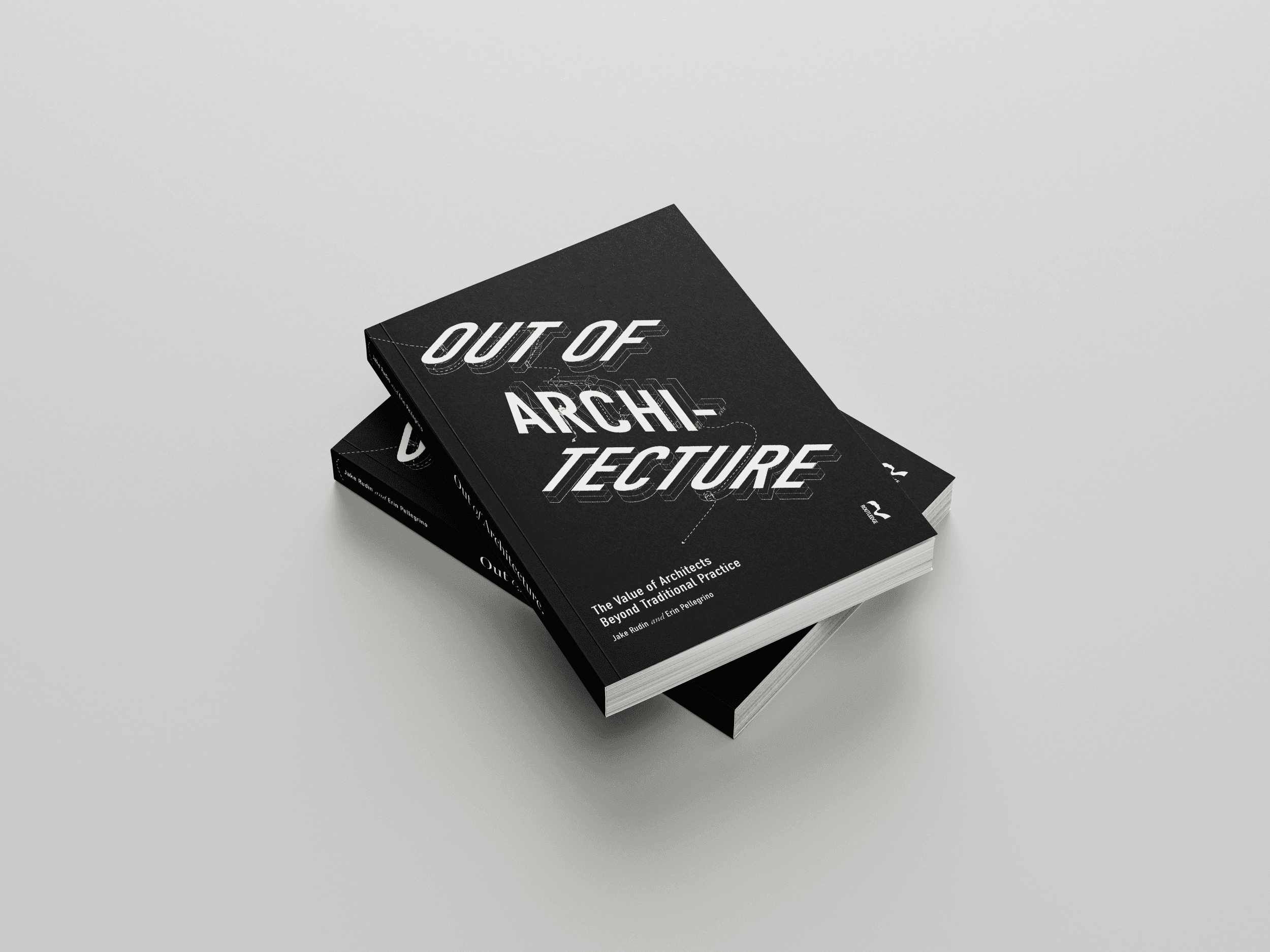
| Out of Architecture (book) | Framework for untangling skills, passions, and value beyond practice | Routledge / Amazon |
| Careers in Architecture and Beyond | Career paths one can pursue with a degree in architecture | ARCHCareersGuide.com |
| The Collective | Community, job board, office hours, templates | community.outofarchitecture.com |
| Career consult | 45-minute intro call; credited toward membership | Book a call |
Frequently Asked Questions
How many architects stay in traditional practice?
Recent industry conversation, including Out of Architecture's ACSA webinar, cites that roughly 1 in 4 architects plan to stay in traditional practice. That means many architects and architecture graduates are exploring roles in, out, or adjacent to conventional firm work.
What careers can you pursue with an architecture degree besides becoming an architect?
Common careers for architecture graduates outside traditional practice include UX and product design, real estate development, construction technology, sustainability consulting, project and program management, brand and experience design, business development, entrepreneurship, research, and organizational leadership. The best fit depends on which parts of architectural training you want to use most.
Is an architecture degree worth it if you leave traditional practice?
Yes, if you use the degree intentionally. Architecture education builds systems thinking, visual communication, project coordination, stakeholder management, and creative problem-solving. Those skills are valuable across industries when translated into business language and supported by targeted networking.
What skills from architecture transfer to other industries?
The most transferable skills include design thinking, critical thinking, visual storytelling, systems analysis, creative problem-solving, project management, client communication, interdisciplinary collaboration, and leading work under constraint.
How do I start transitioning out of architecture?
Start by identifying what you want to keep and leave behind. Then translate your project experience into outcomes language, conduct informational interviews in 3–5 target roles, test a short list of paths through projects or freelance work, and build community with others making similar moves.
Does Out of Architecture only help licensed architects?
No. Out of Architecture supports architects, interior designers, landscape architects, urban planners, engineers, and other design-trained professionals exploring careers in, out, and adjacent to traditional practice.
Where can architecture students learn about non-traditional career paths early?
Students should ask faculty and career services for alumni examples, attend webinars such as the ACSA / Out of Architecture series, and review career maps before choosing internships and electives.
Key Takeaways
- 3 in 4 architects are not planning to stay in traditional practice, so career diversity is the norm, not the exception.
- Architectural education still has high value; the challenge is alignment between training and available conventional roles.
- Skills from studio and practice map directly to business success competencies employers want across industries.
- Students should see the full career map early — not just the path to licensure.
- Translation, testing, and community — not starting over — are the core moves in a successful transition.
About Out of Architecture
Out of Architecture is the largest career-focused community for architects, interior designers, engineers, and allied professionals looking to maximize their value in, out, and adjacent to traditional practice. Since 2018, we have guided 10,000+ coaching conversations and helped 300+ companies hire design-trained talent. We offer 1-on-1 coaching, employer recruiting, and The Collective membership for job seekers exploring what's next.
Ready to Explore Your Path?
Out of Architecture has guided 10,000+ design professionals through career transitions in, out, and adjacent to traditional practice.